
Fukushima information sheet
An unprecedented natural disaster
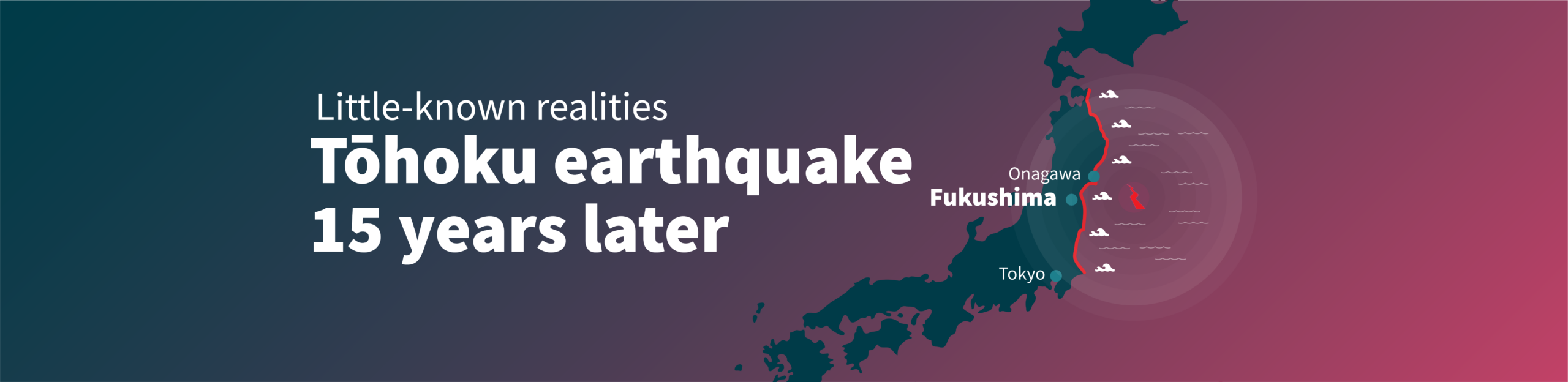
A historic earthquake
- Epicenter 140 km from the power plant.
- Magnitude 9.1 on the Richter scale (4th most intense earthquake recorded since 1300).
- The largest earthquake in Japan’s modern history.
A thousand-year tsunami
- The wave penetrated up to 10 km inland.
- Wave ranging from 20 to 30 m in height at the epicenter, 15 m on the coasts, i.e. a 6-story building.
- Speed: 800 km/h at the time it hit the coasts, 50 km/h inland.
The nuclear accident and political consequences
Nuclear accident
- 12/03 – 18/03: Japanese authorities classified Fukushima as a level 4-5 accident on the INES scale.
- 12/04: upgrade to level 7 INES Japan.
- The French authorities considered that Fukushima should be classified as a level 6 accident.
- For comparison, level of other accidents: TMI INES 5 (1979), Chernobyl INES 7 (1986), Blayais INES 2 (1999),
- 4 accident reactors: Units 1 to 4 suffered a core meltdown and a hydrogen explosion.
- Unit 4 – damaged due to a common pipe with unit 3.
- Units 5 and 6 did not suffer any major damage.
- 52 other industrial accidents recorded in the region.
- 10 times less radioactive discharges than at Chernobyl.
Government response
- 2010: 54 operational nuclear reactors.
- 2012: Total shutdown.
- Resumed in 2018, 24 definitively stopped, 11 in the process of upgrading to standards, 9 have restarted.
- 2010: Nuclear energy accounted for 29% of Japan’s electricity mix.
- 2012: This percentage fell to 2% and a reconstruction plan for the region was put in place
- 2013 Tokyo has questioned its ambitions regarding climate protection.
- At the same time, the government claimed to want to reduce its emissions by 26% in 2030 and 80% in 2050.
- Coal-fired power generation replaced nuclear power.
- 2015: Shinzo Abe wants nuclear to represent 20 to 22% of the electricity mix in 2030.
- 2019: Partial resumption brought it up to 6.3%.
- 2022: Publication of Japan’s energy policy which confirms the objective of 20-22% nuclear power in the electricity mix.
- 2024: Nuclear power provided 8% of the country’s electricity.
- 2025: The 7th energy plan provides for the objective of 20% nuclear energy in the electricity mix by 2040.
- This is the first time since 2011 that the strategy foresees “maximization” of nuclear production rather than a reduction.
- In 2025, this percentage of nuclear power generation increased to about 10%.
- Today, 15 reactors have been restarted since 2018 and 18 others are undergoing upgrades.

Origin of Japanese electricity production by source, before Fukushima (2010), after (in 2013, when the first reactor was restarted), and in the future (target according to the Abe government’s energy plan published in 2016).
Design: the authors; According to the CRE file “Japan and Smart Grids”
Situation for the population
Losses
-
18,000
- + people killed in the tsunami.
- 0 deaths observed or expected (UNSCEAR and WHO), 1 compensation following a complaint with no established medical link.
- 8 people killed upon rupture of the Fujinuma dam.
- 2 workers died on the worksite.
Evacuation
- Evacuation area: 20 km around the power plant, or 1,150 km².
- In total, ~160,000 residents of Fukushima Prefecture were displaced as a result of the nuclear accident.
- 86,000 people considered to be evacuated;
- 26,000 people who preferred to leave for fear of being evacuated later;
- 48,000 people voluntarily left given the situation.
- ~2,200 deaths during the evacuation, 90% of the victims were over 60 years old, the stress of the evacuation and the lack of care were the main causes of post-tsunami mortality.
- July 2011: Establishment of criteria for lifting the evacuation order.
- 2014-2017: Evacuation order lifted in many towns in the area (Tamura, Naraha, Katsuaro)
- 2021: The Prime Minister partially lifted the evacuation order in the outskirts of Fukushima (Futaba, Okuma,
- Tomokia).
- Return of 20% of the inhabitants of the exclusion zone, this average varies from 0% to 75% depending on the locality.
Waste and radiation
- Since 2011, the overall ambient dose rate has been divided by a factor of at least 2.
- The number of cancers remains within the national average (especially for thyroid cancer).
- 1.18 million tons of contaminated water stored.
- The current volume of waste stored at the ISF (Interim Storage Facility) is estimated at about 14 million m³ on about 1,600 hectares.
Radiological impact on the population
- Below 100 mSv (millisievert), no long-term health effects have been demonstrated.
- The number of cancers remains within the national average (especially for thyroid cancer).
- 1.18 million tons of contaminated water stored.
- The current volume of waste stored at the ISF (Interim Storage Facility) is estimated at about 14 million m³ on about 1,600 hectares.
The situation in Fukushima
- At no time did the environment and territories outside the scope of the site exceed this threshold, the vast majority of rates remained much lower.
- The impact is undetectable following favorable weather from the beginning of the accident.
- Estimated dosimetry is low.
- 99% of the population was exposed to less than 3 mSv based on the measurements.
- Maximum reached was 25 mSv on 421,000 individuals.
- The regulatory limit ranges between 100 and 250 mSv/year for workers inside the Fukushima site.
- According to UNSCEAR, 174 workers exceeded the 100 mSv threshold, none had any health complications at this stage.
Reminder of the exposure limits allowed in France
- 1 mSv/year: Effective dose limit received by the population as a result of nuclear activities.
- 2.9 mSv/year: Average natural exposure of the public.
- 4.5 mSv/year: Average natural and medical exposure.
- 20 mSv/year: Regulatory exposure limit for a French nuclear worker.
Accidental situation
- > 10 mSv/year: Sheltering populations must be recommended. This dose is equivalent to 3 times the annual dose received by the French population.
- > 50 mSv/year: Evacuation is recommended.
- In a crisis situation the allowed limit can increase up to 300 mSv.
Medium-term consequences
Public health
- In 10 years: thousands of premature deaths in Japan as a result of pollution caused by coal-fired power plants.
- 1,200 people/year die in France because of this same pollution due to coal.
- 23,000/year in Europe.
- 366,000/year worldwide.
- In a decade the carbon intensity of Japanese electricity has increased by more than 30% from 420 gCO eq/kWh in 2010 to 518 gCO eq/kWh in 2018.
- In 2018, the electricity and heating sector emitted 25 million tons more CO2 than in 2010.
- In 2019, Japan became the 5th largest CO emitter in the world (France: 21st). It is also the 1st
- importer of liquefied natural gas (LNG), the 3rd for coal, and 4th for petroleum.
- Restarting of 9 reactors from 2018 to 2021 saved 30,000,000 tons eq/CO.
Economic
- GDP growth: +4.4% in 2010, -0.4% in 2011 following the disaster.
- 52% increase in fossil fuel imports after 2011.
- 38% increase in electricity prices after the nuclear shutdown.
- Up to 4,500 people have died from the cold as a result of this increase.
- The infrastructure reconstruction work is 95% complete.
- Generation from natural gas has declined every year since 2017 as nuclear reactors have slowly restarted and the production of renewable energies, mostly solar, has increased.
- Cost of dismantling: 60 billion euro.
- Cost of decontamination: 180 billion euro.
- Japan had the 3rd largest nuclear industry in the world before the disaster, it is now 6th.
- International tourism: Decreased 62% between 2010 and 2011.
And where did we get this information?
A thousand-year tsunami
https://www.asn.fr/annual_report/2011fr/en_2011/fukushima-un-an-apres.html
A historic earthquake
Accident
https://recherche-expertise.asnr.fr/savoir-comprendre/crise/accident-fukushima-daiichi-japon-2011
https://www.npa.go.jp/news/other/earthquake2011/pdf/higaijokyo_e.pdf
https://www.afis.org/L-echelle-INES-des-incidents-et-accidents-nucleaires#ref23
Government response
https://fukushima-updates.reconstruction.go.jp/fr
https://www.meti.go.jp/earthquake/nuclear/hairo_osensui
https://www.pref.fukushima.lg.jp/site/portal-fr
https://www.nippon.com/fr/japan-data/h02619/?cx_recs_click=true
https://www.cas.go.jp/jp/seisaku/gx_jikkou_kaigi/dai5/siryou1.pdf
https://www.enecho.meti.go.jp/en/category/others/basic_plan
https://www.nippon.com/en/in-depth/d01195
https://www.cas.go.jp/jp/seisaku/gx_jikkou_kaigi/dai5/siryou1.pdf
https://www.edelmanglobaladvisory.com/japans-seventh-strategic-energy-plan
https://www.nippon.com/en/in-depth/d01195
https://www.eia.gov/todayinenergy/detail.php?id=67244
Losses and evacuations
https://www.reconstruction.go.jp/english/topics/GEJE/index.html
https://www.unscear.org/unscear/en/areas-of-work/fukushima.html
https://sfrp.asso.fr/wp-content/uploads/2021/11/S1_A_A_RANNOU.pdf
https://www.nber.org/papers/w26395
Radiological impact on the population
https://reglementation-controle.asnr.fr/autres-activites/post-accident/le-codirpa
https://laradioactivite.com/articles/energie_nucleaire/doses_intervenants
https://sfrp.asso.fr/wp-content/uploads/2021/11/S1_A_ARANNOU.pdf
Medium-term consequences
https://www.sciencedirect.com/science/article/pii/S0301421519303611
https://www.sciencespo.fr/ceri/sites/sciencespo.fr.ceri/files/art_gd.pdf
https://www.enecho.meti.go.jp/en/category/special/article/detail_207.html